crane / Tower crane 3-in-1 visual safety system
Tower crane 3-in-1 visual safety system
This "three-in-one" visual safety system for tower cranes utilizes a modular industrial platform design and features an 11.6-inch 1080P IPS display unit that monitors load, moment percentage, weight, anti-collision status, working radius, height, tilt angle, and wind speed in real time. It integrates a hook-tracking camera, a 360° panoramic imaging system, in-cab facial recognition, and millimeter-wave radar. The system employs wireless bridge transmission technology (ensuring zero latency), boasts an IP67 protection rating, and operates within a temperature range of -30°C to +70°C. It comes equipped with magnetic sensors (allowing for installation without cutting), a wired mouse, and a 12V in-cab power adapter. Comprehensive technical documentation is provided to meet the requirements for special equipment inspections and "smart construction site" acceptance standards.
Request a technical proposalKey specifications
- capacity
- Truck crane 8-200t mainstream, boom length learned
- material
- IP67 cameras, -30 to +70C, magnetic wireless, cab transformer 18-32V to 12V
- compliance
- Special-equipment inspection docs packet, smart-site acceptance
- communication
- Wireless TX/RX industrial <150ms, 485 for radar, USB for face-ID/mouse
- safety_factor
- Moment % + radius + height + tilt + wind multi-limit
Application overview
Specified around the application
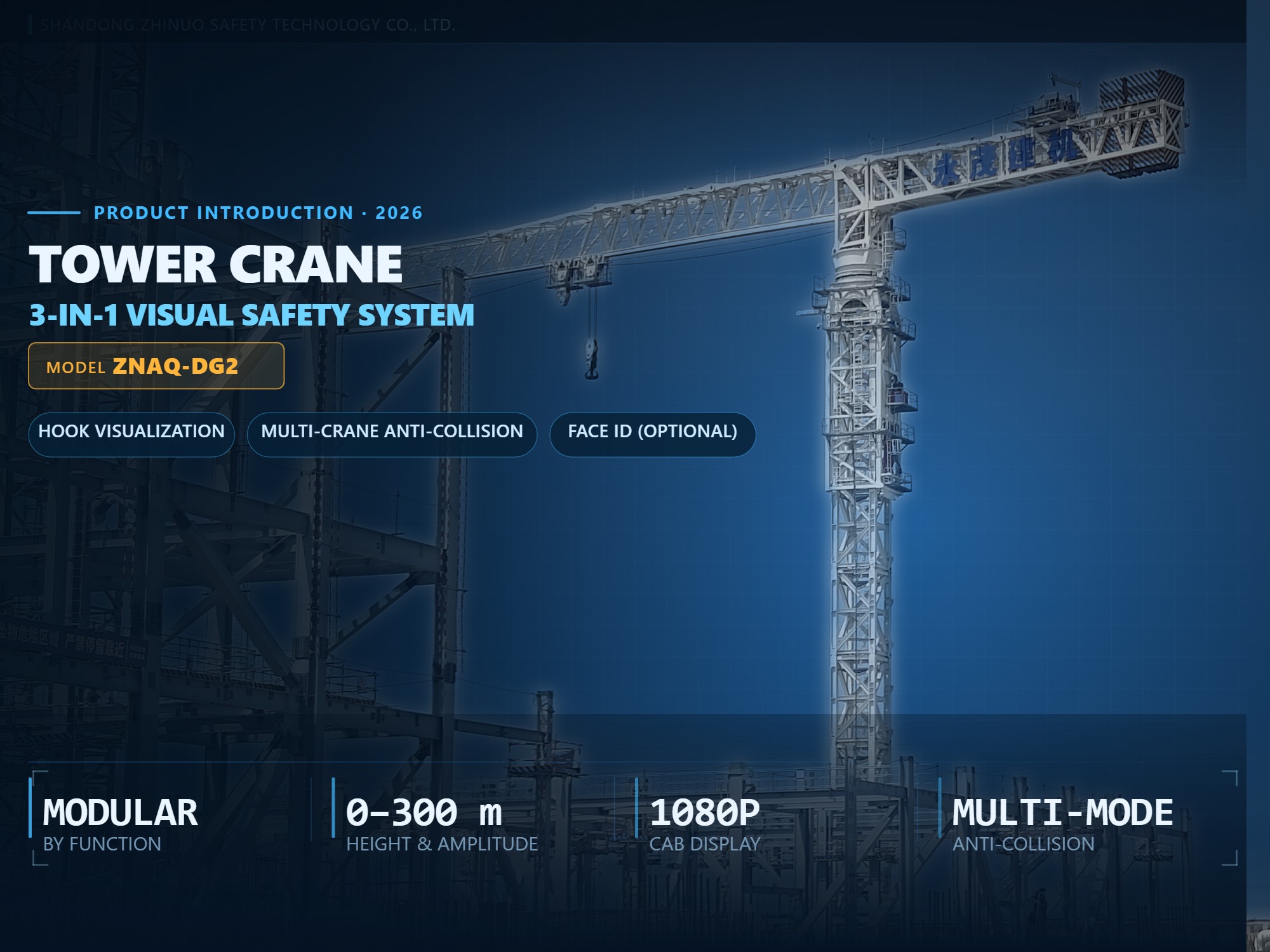 01PRODUCT OVERVIEW · ZNAQ-DG2
Tower crane 3-in-1 visual safety system
One kit covers three jobs: hook vision, multi-crane anti-collision and driver identity. A single 11.6-inch screen in the cabin shows the live hook picture and the working data — height, amplitude, slewing, load, inclination and wind speed. Every sensor is fitted to the structure the crane already has, with no structural change, and one host in the cabin does the calculation and the communication for the whole crane.
The system is modular by function: hook vision only, hook vision plus multi-crane anti-collision, or the same hardware with face recognition added — the difference is configuration, not equipment.
Modular by function — one kit per tower crane
Height and amplitude range 0–300 m
1080P hook picture to the cabin screen and the site office
Several anti-collision modes run at the same time
Face recognition is optional
 02SYSTEM COMPOSITION · STANDARD CONFIGURATION
What goes on the crane
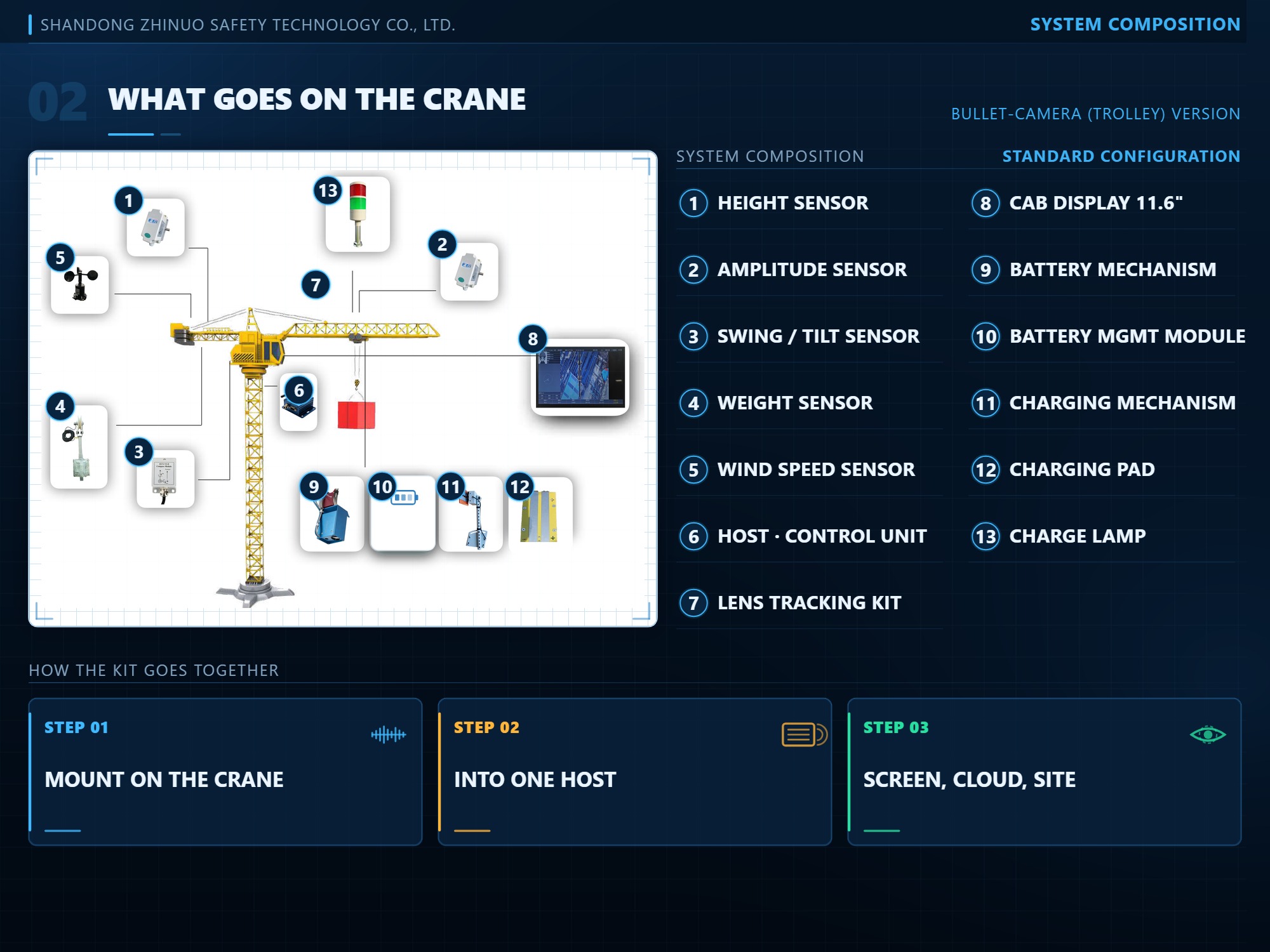
The standard configuration is one unbroken chain from sensor to cloud. Two absolute encoders read height and amplitude; a Beidou rotation and tilt module covers slewing and inclination; load goes through real nylon wheels on a thickened bracket; wind speed uses ABS cups. The lens tracking kit rides the trolley with the hook, and the host in the cabin collects every camera, sensor and alarm, does the calculation and drives both the cabin display and the 4G link. The battery mechanism, battery management module, contact charging mechanism, charging pad and charge lamp keep the kit powered — the crane picks up power as soon as it slews.
Every number on the drawing matches one mounting position in the assembly view: sensors and vision first, then host, cabin display and lens tracking kit, then the power and charging parts.
Height / amplitude: absolute encoder, 0–300 m, 0.1 m, IP65
Slewing / inclination: Beidou module, 360° / 1°, 0–15° / 0.01°
Load: 0–10 t, ±5% accuracy, 0.01 t resolution
Wind speed: 0–60 m/s, start-up 0.2 m/s
Host: 4G link, drives the cabin display and the cloud platform
Three steps: mount the sensors → one host → screen, cloud, site
 03CORE HARDWARE
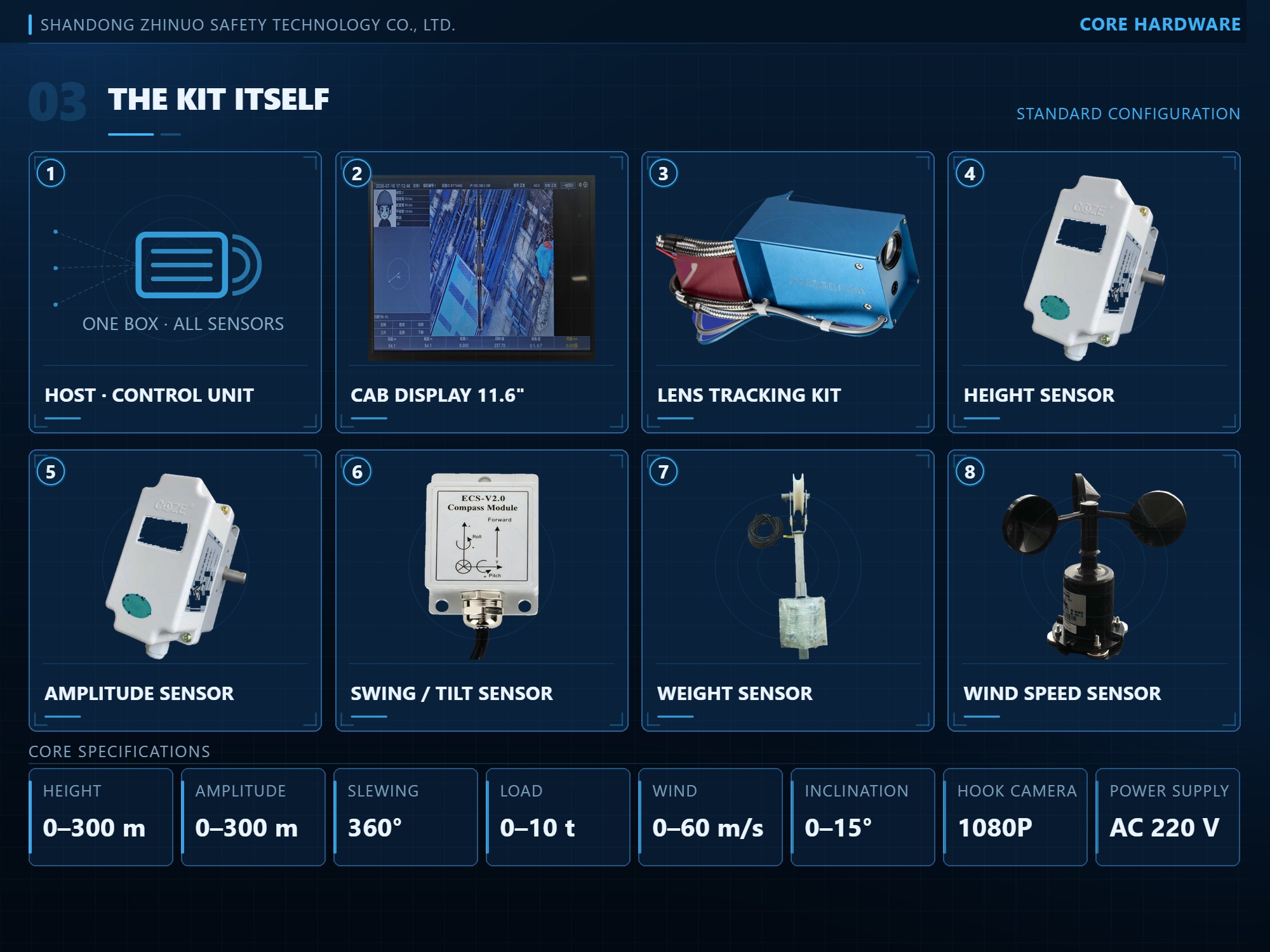
One host, one screen, one camera, five sensors
Every unit comes from our own production. The host is the centre of the system: cameras, sensors and alarms all report to it, and it does the calculation and the 4G communication. The cabin display is an 11.6-inch, 1920×1080 tempered glass panel running on AC 220 V at no more than 20 W, expandable to four screens in a long cabin. The lens tracking kit is a trolley-mounted bullet camera with a 2 MP , 23× optical zoom, IP65 and DC 12 V — it moves with the trolley and the hook, so there is no blind zone.
Five sensors turn every movement of the crane into a readable figure: height, amplitude, slewing and inclination, load, and wind speed. All of them are IP65 and maintenance-free once fitted.
Max height 0–300 m, 0.1 m resolution
Max amplitude 0–300 m, 0.1 m resolution
Slewing 360° / 1°; inclination 0–15° / 0.01°
Rated load 0–10 t, ±5%, 0.01 t resolution
Wind speed 0–60 m/s, start-up 0.2 m/s
Hook picture 1080P (2 MP · 23× zoom)
Power supply AC 220 V / 50 Hz, ≤ 20 W in total
04CORE FUNCTIONS
See the hook, keep the cranes apart, know who is driving
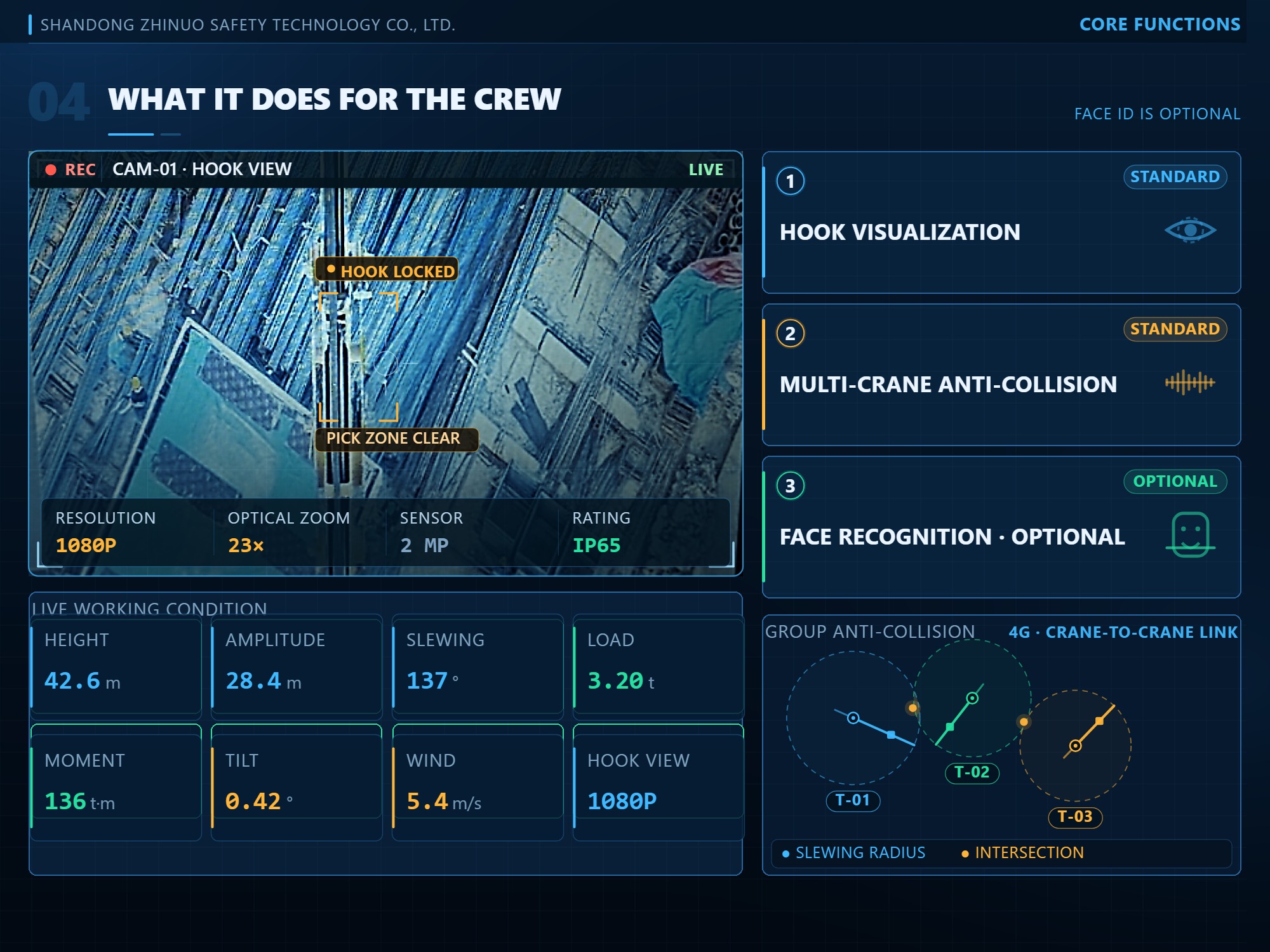
Hook vision is the first line of defence on every tower crane: the camera rides the trolley and puts the hook and the landing area straight into the cabin, so the operator is never lifting blind. Multi-crane anti-collision sets slow-down, warning and stop zones per crane; each tower sends its own angle and position to its neighbours over 4G, so an alarm comes before two jibs can reach into each other's working area. Face recognition is optional: if the face on the seat does not match a registered identity, the equipment will not release control — cards can be handed over and keys shared, but a face cannot, and every unlock is tied to a named driver.
The right-hand side of the page is the screen the operator watches: height 42.6 m, amplitude 28.4 m, slewing 137°, load 3.20 t, moment 136 t·m, inclination 0.42°, wind 5.4 m/s — plus the 1080P hook picture. Every figure refreshes with the picture, so the crew can judge the working condition at a glance.
Hook vision and anti-collision are standard; face recognition is optional
Slow-down, warning and stop zones configured per crane, per site
Unlocks are tied to a named driver and can be traced
The same stream reaches the site office and the cloud over 4G
05THE SITE · LIVE PROJECTS
What the site actually sees
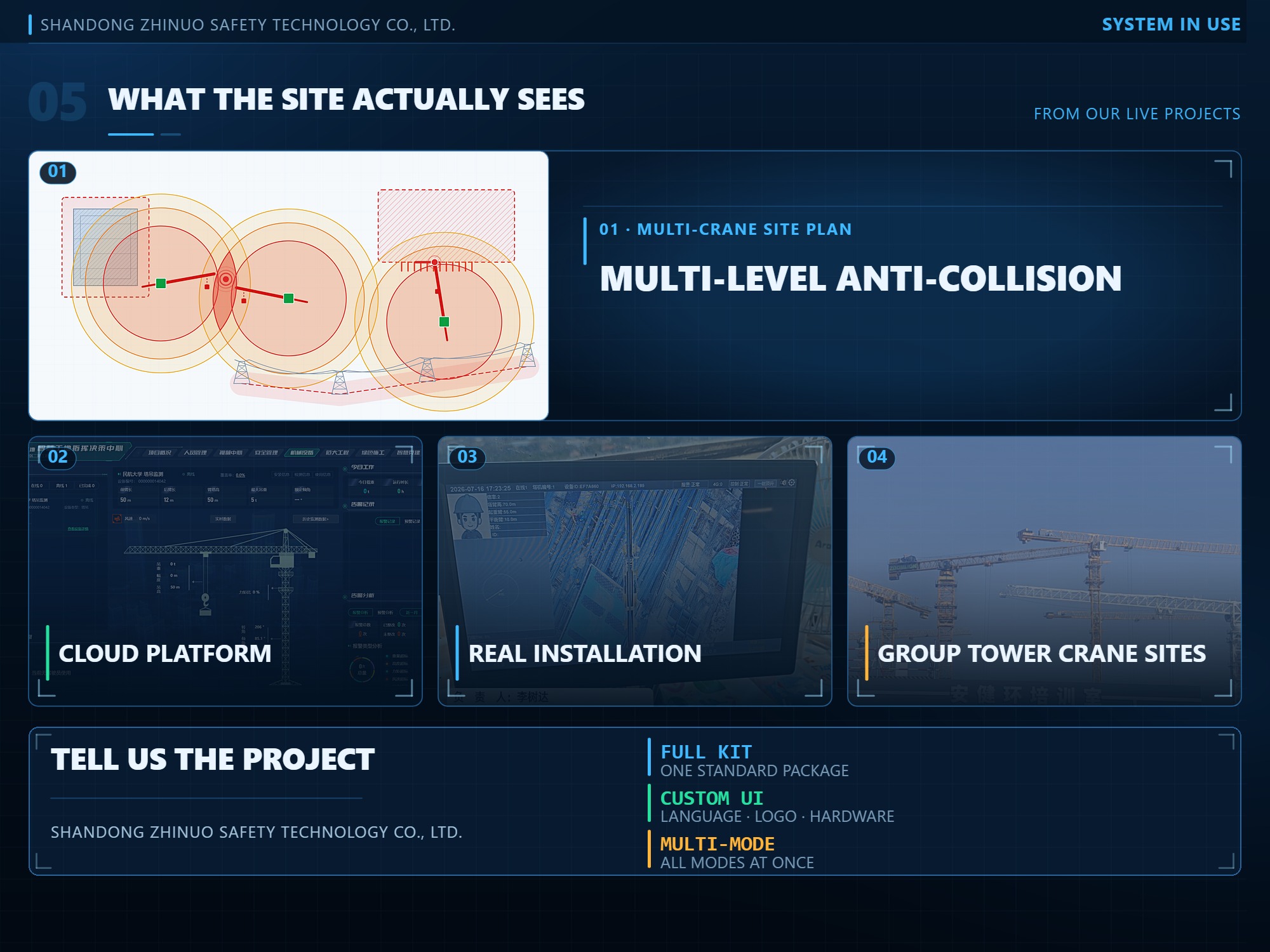
Four views of one system on a real site. On the plan, the slewing envelope of every crane is drawn together with the site obstacles, so the overlapping working zones between neighbouring towers are obvious. The cloud platform puts every crane, every reading and every alarm on one dashboard, at the site office or on a phone. The cabin photograph comes from a tower crane in Bontang, Indonesia, with the live hook picture and the working data on the same screen. The tower group is where the kit earns its keep: the cranes exchange position and angle over 4G, and the system knows which jib will enter whose zone before the operators do.
Software language, logo and hardware configuration can be customized for your market. Tell us the site, the crane model and how many towers — we will configure the kit and quote it.
Plan / cloud platform / cabin photo / tower group — four site views
Software language and logo customizable
Hardware configuration built per project, sensor to cloud as standard
Several anti-collision modes run at the same time, not one or the other
Contact: shandongzhinuo@outlook.com · +86 176 6371 0314 · www.znaqkj.com
Product gallery
Visual context for configuration review
Next step
Compare related products
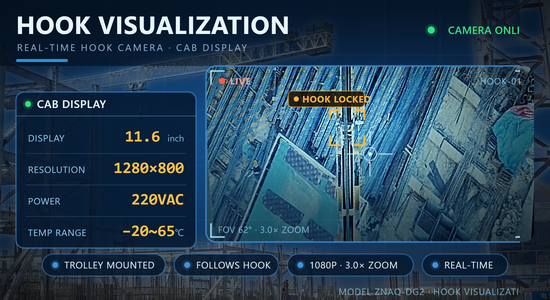
Hook Visualization System — HD Camera + Cab Display for Tower & Truck Cranes
Hook Visualization System — HD along-boom (trolley/boom-tip) camera with auto-zoom streams via low-latency wireless TX/RX to cab display (11.6in 1080P IPS or 7–10in). For tower & truck crane blind & night lifts; optional IR night-vision + ZNAQ-JG1 laser landing reference, ONVIF/RTSP overlay of load/radius/height when integrated with ZNAO-TG2 or truck host, IP67 magnetic.
Hook Visualization System — HD Camera + Cab Display for Tower & Truck Cranes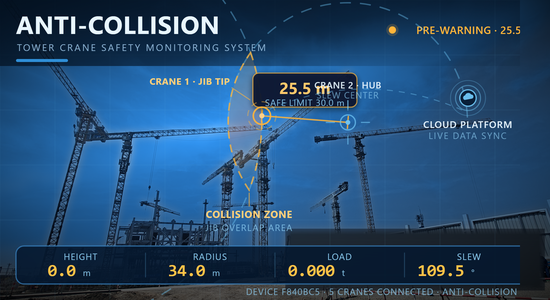
Tower Crane Safety Monitoring System — ZNAO-TG2 Black Box
ZNAO-TG2 Tower Crane Safety Monitoring System (Black Box) — 6-dimension real-time sensing (height, trolley radius, slew, load, wind, tilt) with smart exceedance alarm, group tower anti-collision auto-networking, 8-zone line/triangle/quadrilateral/circle limiting, IP67 11.6in 1920×1080 industrial display, 4G+433M with RS485/LAN/ONVIF for hook cameras and platform docking.
Tower Crane Safety Monitoring System — ZNAO-TG2 Black BoxNeed documentation or a technical review?
Send the project inputs and we will confirm suitability, configuration, documentation, and delivery options.
Online inquiry
Request a quotation for this product
Describe the application and site conditions, and our engineering team will confirm configuration, documentation, and delivery.